Bubbles of boiling hot vapour push the surface upward until they break through and Strokkur erupts. In the Netherlands we call these geothermal steam-eruptions ‘geisers’. This generic name is derived from this specific spot: Geysir in Iceland…
Steamy Strokkur. Minus ten degrees Celcius (fourteen Fahrenheit) makes it bloody cold right next to this boiling pond.
Geothermical area around Geysir and Strokkur. Steam everywhere…
Another geothermal area is Krysuvik or Seltun. A small path leads through the hot springs and steamy rivers.
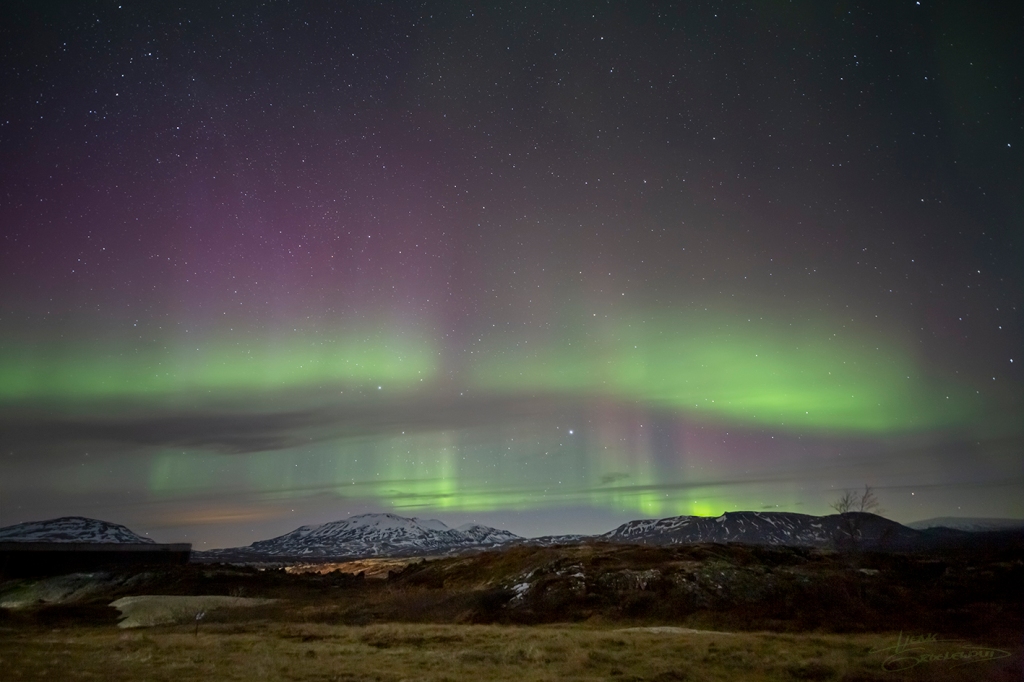
As a young boy I had a book with stories from all over the world. It had a drawing of a lone fur trapper in the woods, staring at the northern lights sky. I loved that drawing. Such wildness, such loneliness and such beauty! I dreamt of being in the wild myself and seeing the aurora borealis. But I had visited Iceland in summer once, with 5 days of just clouds and rain and wind (We were camping then, my daughter and I, and after 4 days of rain we fled into the first hotel we could find to get dry. Despite the rain and the clouds and the wind it was a great holiday, for even when it rains Iceland is really beautiful).
So I hesitated. What were the chances of going in winter and having both an active aurora and a clear sky? For years I didn’t dare to take the risk and buy a ticket.
Until last November, when I realised that if I didn’t try, I would surely never see it. I bought a ticket and… well, see for yourself.
There’s no need to go to a special dark place to see the aurora. You can see it right from the city. Reykjavic for instance, or more precisely: the bay of Kopavogur.
Venus guided us all the way home after the Vienna trip. The picture from the plane resembles a bit the picture I took at home a few days ago, with Jupiter and Venus in conjunction.
Tonight, Venus and Jupiter are standing very close together in the sky. That is: they’re standing very, very far apart, but they appear to look close together to us.
In the sunset picture you can see them cosily in the top right corner, in between the greylag geese. Beautiful sunset today.
I also took a few pictures with the standard 500 mm lens, and was very surprised about the details. You actually see the little balls in the sky, and a few moons around Jupiter. Always makes me feel like that little boy, staring into the sky with a small telescope and dreaming of the stars…
Let me take you to another magnificent place with dinosaur footprints. Above is the breathtaking view from Monte Pelmetto in the Italian Dolomites.
Turning a little to the right youy see a rock that broke off from Monte Pelmetto and came tumbling down. Look carefully! Do you see the tiny dots?
These prints are even older than the prints from Portugal. They date back to some 220 million years ago, the Triassic period, when the mountains still had to born and this was a flat and muddy area. Three different species have left their marks here. According to sources I cannot verify these were probably Ornithischia, Celurosauri and Prosauropoda.
A special place in the Algarve is Salema Beach, Praia da Salema, near Vila do Bispo. There you can find well preserved dinosaur footprints right at the beach. As you can see, the toes are round and without claws, which indicates that these are the prints of a herbivore, an Ornithopod, a bit like an Iguanodon.
It is estimated that these prints are roughly 130 million years old, dating from the Early Cretaceous. Standing in these footprints of dragons long ago spurred my imagination with fantasies of time machines and walking between those animals in another era.
Let me show you one of the magnificent beaches in the Algarve! Lovely to spend some time here, in between the chase for dinosaur prints at Salema.
Incredible to witness these dinosaur tracks and imagine how some 130 million millions years ago, huge lizards roamed this place. Salema Beach has more footprints, but they are well hidden. You´ll probably need a local guide to help you out, for even if you are standing close to these vertical rock formations the prints are difficult to see. António Alfarroba pointed them out. As you can see this one does have claws, so it must have been hunting for prey here. I´m afraid I haven´t been able to find out the exact species – if you do know it, you’re welcome to mention it.
Something completely different. Bread. The very first I ever baked, and it means so much to me! You have no idea. I took a huge risk given the visitor I expected. Simple recipe: whole grain flour, yeast, water and the simplest oven you can imagine. And it worked! It’s like magic.
Lovely to see the first ones of the year. In the backyard here in Hollandsche Rading, the winter jasmine is abundantly flowering.
Seeing this I realised I desperately need more yellow and summer colours. So this one is of a summer that feels so long ago.
Last one is of a visit to the Museum Voorlinden in Wassenaar. There are a few items on permanent display that bring out the inner child in everyone – at least, they definitely did in me. Like Leandro Erlich’s swimming pool, Ron Mueck’s Couple under an Umbrella, the Open Ended maze of Richard Serra and the tiny elevators of Maurizio Cattelan.
At the moment there is an exhibition of the Italian artist Guiseppe Penone, who works with natural materials like trees and marble and leather, using the objects as a kind of memory or footprint of what has been. If you allow your mind to wander in his world, thoughts of interconnectedness of all visible and physical objects come up, of memories in the physical world and how we give meaning to what we experience with our senses.
This picture below is of Tiger, tiger, tiger; the hidden tigers at the bottom of porcelain of the Ming Dynasty of Ai Weiwei.
After the hailstorm Aphrodite showed her kindness. When we drove back along the coast, right at the place where according to the legends she had come ashore so long ago, she surprised us with a stunning sunset. Aphrodite’s rock, near Paphos, is a mythical place. It is said that if you swim around the rock, you will find true love. I’m afraid I only read that the next day…