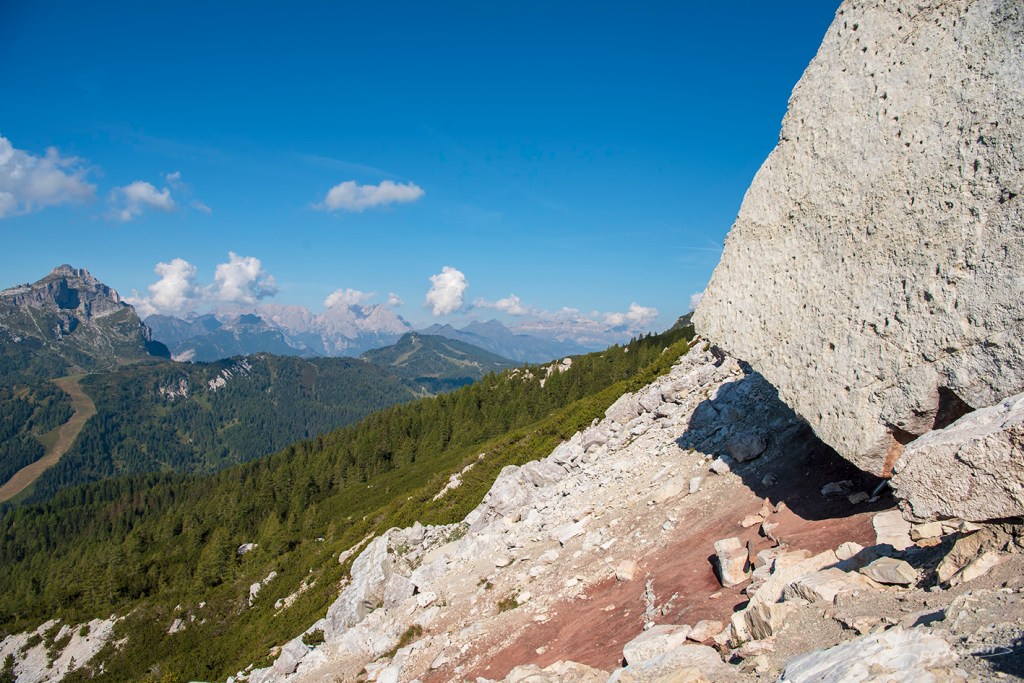
Let me take you to another magnificent place with dinosaur footprints. Above is the breathtaking view from Monte Pelmetto in the Italian Dolomites.
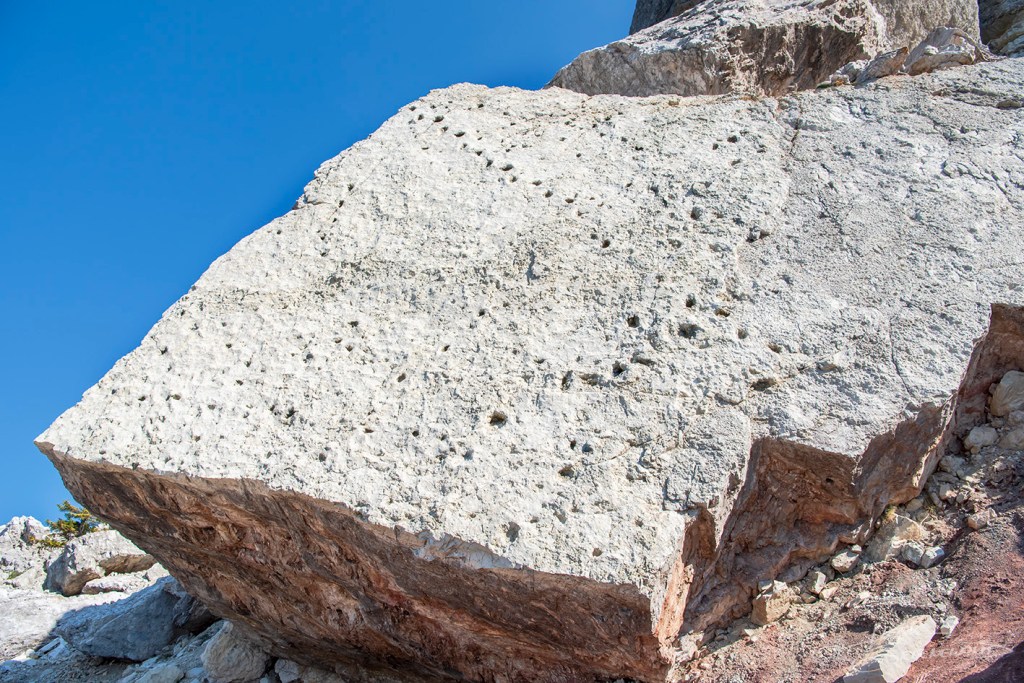
Turning a little to the right youy see a rock that broke off from Monte Pelmetto and came tumbling down. Look carefully! Do you see the tiny dots?
These prints are even older than the prints from Portugal. They date back to some 220 million years ago, the Triassic period, when the mountains still had to born and this was a flat and muddy area. Three different species have left their marks here. According to sources I cannot verify these were probably Ornithischia, Celurosauri and Prosauropoda.
A special place in the Algarve is Salema Beach, Praia da Salema, near Vila do Bispo. There you can find well preserved dinosaur footprints right at the beach. As you can see, the toes are round and without claws, which indicates that these are the prints of a herbivore, an Ornithopod, a bit like an Iguanodon.
It is estimated that these prints are roughly 130 million years old, dating from the Early Cretaceous. Standing in these footprints of dragons long ago spurred my imagination with fantasies of time machines and walking between those animals in another era.
Let me show you one of the magnificent beaches in the Algarve! Lovely to spend some time here, in between the chase for dinosaur prints at Salema.
Incredible to witness these dinosaur tracks and imagine how some 130 million millions years ago, huge lizards roamed this place. Salema Beach has more footprints, but they are well hidden. You´ll probably need a local guide to help you out, for even if you are standing close to these vertical rock formations the prints are difficult to see. António Alfarroba pointed them out. As you can see this one does have claws, so it must have been hunting for prey here. I´m afraid I haven´t been able to find out the exact species – if you do know it, you’re welcome to mention it.
Something completely different. Bread. The very first I ever baked, and it means so much to me! You have no idea. I took a huge risk given the visitor I expected. Simple recipe: whole grain flour, yeast, water and the simplest oven you can imagine. And it worked! It’s like magic.
Lovely to see the first ones of the year. In the backyard here in Hollandsche Rading, the winter jasmine is abundantly flowering.
Seeing this I realised I desperately need more yellow and summer colours. So this one is of a summer that feels so long ago.
Last one is of a visit to the Museum Voorlinden in Wassenaar. There are a few items on permanent display that bring out the inner child in everyone – at least, they definitely did in me. Like Leandro Erlich’s swimming pool, Ron Mueck’s Couple under an Umbrella, the Open Ended maze of Richard Serra and the tiny elevators of Maurizio Cattelan.
At the moment there is an exhibition of the Italian artist Guiseppe Penone, who works with natural materials like trees and marble and leather, using the objects as a kind of memory or footprint of what has been. If you allow your mind to wander in his world, thoughts of interconnectedness of all visible and physical objects come up, of memories in the physical world and how we give meaning to what we experience with our senses.
This picture below is of Tiger, tiger, tiger; the hidden tigers at the bottom of porcelain of the Ming Dynasty of Ai Weiwei.
After the hailstorm Aphrodite showed her kindness. When we drove back along the coast, right at the place where according to the legends she had come ashore so long ago, she surprised us with a stunning sunset. Aphrodite’s rock, near Paphos, is a mythical place. It is said that if you swim around the rock, you will find true love. I’m afraid I only read that the next day…
Was she angry? For three days already we were on the island and still had not visited her temple to pay her tribute. This was after all her island. Kronos, leader of the Titans, had castrated his tyrannical father Uranus and thrown his thingy in the sea. Then the water had started to fizz and out of the foam arose Aphrodite, goddess of love, sexuality, fertility and beauty.
On the way to her sanctuary we stopped at the remnants of the ancient city Koúrion. We barely had time to see it. Dark clouds descended from the Olympus, and a hailstorm came upon us so fiercely that it damaged the front window of our car. With the last hailstones still drumming on the car, we drove directly towards the holy temple of the Aphrodite near Paphos. Immediately her mood improved, for the dark clouds drifted to the sea and soon even the sun showed itself again.
Thousands of years ago this place had attracted people from all over the world: the Mediterranean sea with all its islands and many countries in Europe, the Middle-East and Africa. People attended ceremonies and made offerings. The Roman historian Tacitus described the altar and a sacred stone: “Blood may not be shed upon the altar, but offering is made only with prayers and pure fire. The altar is never wet by any rain, although it is in the open air. The representation of the goddess is not in human form, but it is a circular mass that is broader at the base and rises like a turning-post to a small circumference at the top. The reason for this is obscure.”
This was the very stone.
Aphrodite was also depicted in her human form. For the goddess of love and fertility and sexuality, an offer could be to sacrifice the own body as in ancient times, making love was seen as a sacred act.
This idea has roots that go back more than 7.000 years ago, to the Sumerian cult of Inanna. In Cyprus the first settlements dated from 3.300 year before Christ. In that time the Phoenician goddess of Astarte was worshipped, also a goddess of sexuality, fertility and war. In the Greek period, Astarte became Aphrodite, and the city of Paphos was known throughout the world for it’s parties, wine and prostitutes. The stone at this sanctuary never became Venus, as the Roman Emperor Theodosius I outlawed all pagan religions in the year 391 and the sanctuary of Aphrodite fell into ruins.
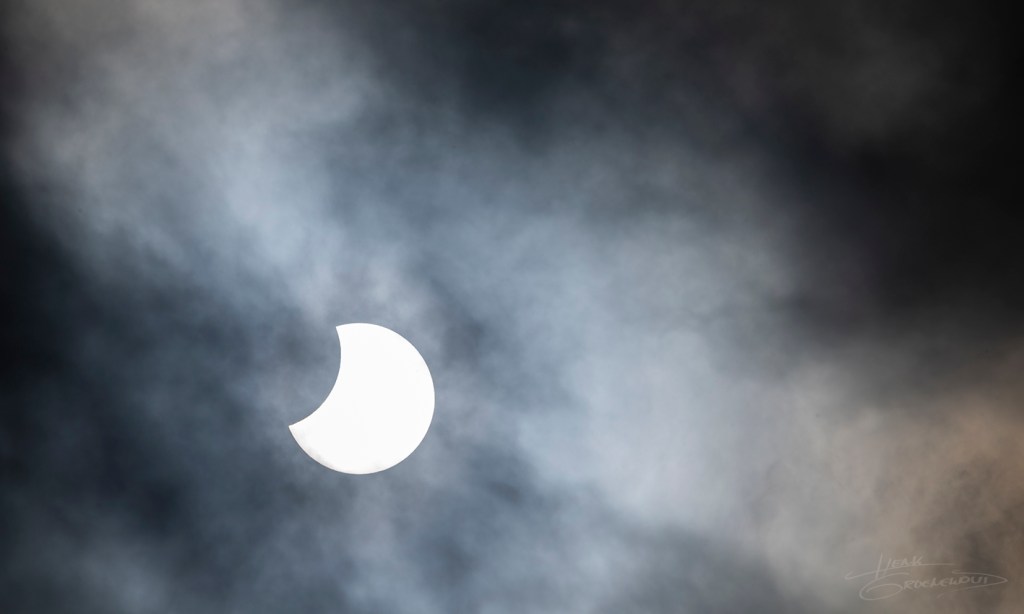
A few days ago I was on the ground with my nose in mushrooms. Today I looked up in the sky. I had completely forgotten about it: the partial eclipse. Fortunately a colleague sent a message: “It’s happening right now!”
I grabbed my camera and ran outside – just in time to see the moon at its maximum cover of one third of the sun.
Same picture twice, just a different crop.
Next show in the Netherlands is predicted in 2025. Already looking forward to it.
I saw a group of fly agarics, very nice for a beautiful night portrait. But when I arrived at the site in the dark, they had disappeared, broken down. Maybe run over by dogs, maybe taken by passers-by, but gone.
Fortunately the flashlight showed a few nice specimens in a meadow along the path. I knelt in the grass, put the flashlight on the camera bag and started to set up my gear: small tripod under the camera, setting ISO / shutter speed / aperture, focus… and then I heard something buzzing and rustling in front of me.
“Must be a beetle!” I thought hopefully. It sounded like a big one. Also nice for a night photo!
The insect jumped to the light, and tried to sort of crawl into the flashlight.
Not a beetle, but a European hornet. Our largest native wasp, even larger than the so-called terror wasp, the Asian hornet. One of those whoppers that you can hear flying by like a helicopter. Immediately afterwards, a second one landed in the illuminated grass. That one also seemed very interested in the light.
European hornets are quite large in their own right, but I did not know that they grew even three times as large in the dark. And that each hornet split into several individuals during the night. That is to say, these two insects sounded like there were five or ten of them.
The first one became bored with the flashlight, and began to inspect my camera. The second one flew first to the light, then to my camera bag. I wondered how I could lie down and operate my gear without running the risk of accidentally grabbing an insect. And I wondered if these two would be the only ones. A memory came to mind: that time when I accidentally sat on the edge of a lake on top of a wasp’s nest in the ground, and after being stung twice in my leg had to run to avoid worse. And I remembered the articles I’d collected about dogs, hikers, and cyclists accidentally getting too close to a ground nest of European hornets and being attacked by an angry swarm. Then the first hornet decided to inspect me.
I turned off the light and took a little distance. And after a minute or so, when all movement and noise subsided, I carefully walked back to get my stuff and go home. No night photo of the fly agarics today.
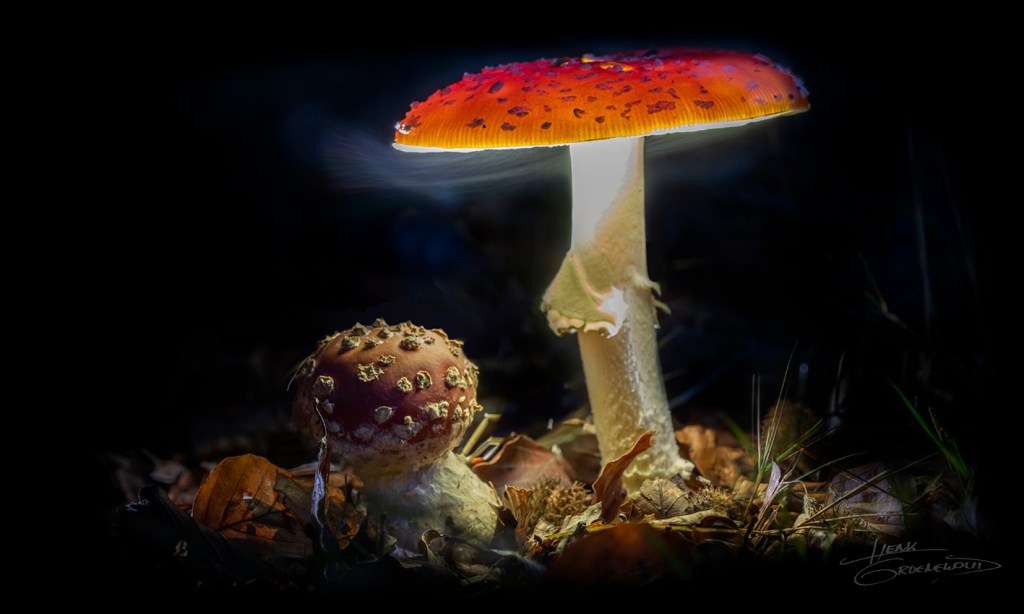
I didn’t go back until two days later. And what I hoped for, succeeded this time: catching the spores being spread by the fly agaric. There is a lot of Photoshop in this photo, but the spores are really real! Wonderful to experience the magic of the forest this way.
I learned a few things. The fly agarics are always redder on the other side of the path. European hornets are three times larger at night than during the day, and split into several individuals at night. And for forest photography you sometimes need a little patience
So I went on this journey of discoveries. Into the unknown. Looking for flatworms…
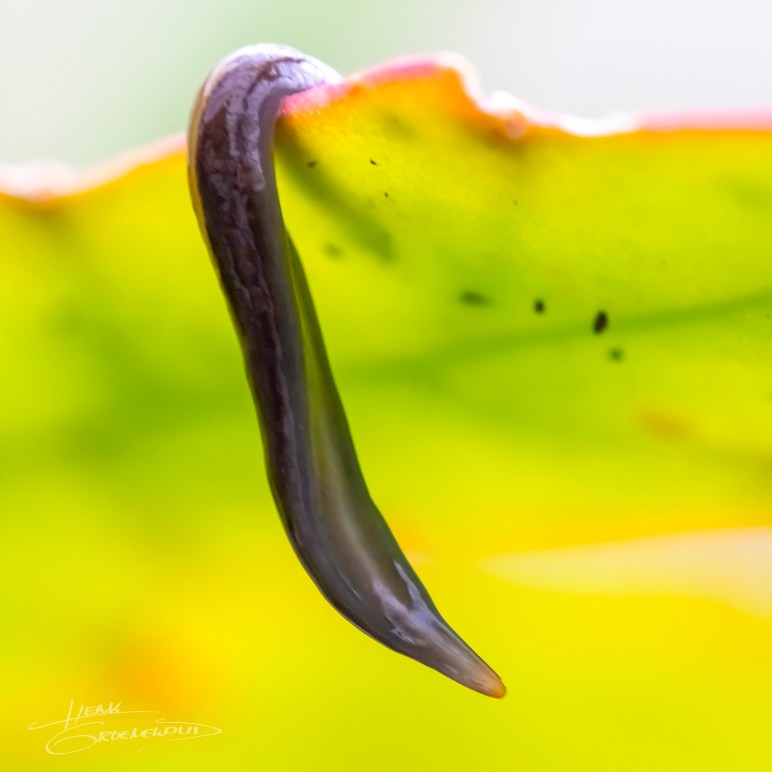
You might think that in the Netherlands we know all about nature, and have discovered everything there is to be discovered. At least that was my assumption. But a few years ago two scientist went out to look for flatworms. Especially for the New Zealand flatworm (Arthurdendyus triangulatus – Nieuw Zeelandse landplatworm) that was put on the European Union list of invasive alien species in 2019 as it is a predator of earthworms – the worms that we need to create fertile soils. Those of you who read The Hitchhikers’ guide to the Galaxy will recognise it’s scientific name 😊. Anyhow, apparently these creatures are so unattractive, that no one ever bothered to look at them or report any findings. There are bird groups, insect huggers and botanical twitchers, but there is not one single flatworm – society.
Fortunately, they didn´t encounter any New Zealand flatworms. But just few visits to zoos, greenhouses, botanical gardens and city backyards resulted in a handful of new species, never before recorded in the Netherlands. If you want the full background, look here.
Nobody cares for flatworms. And I can’t blame anyone. They look like their relatives, the leeches. And I really, really dislike leeches.
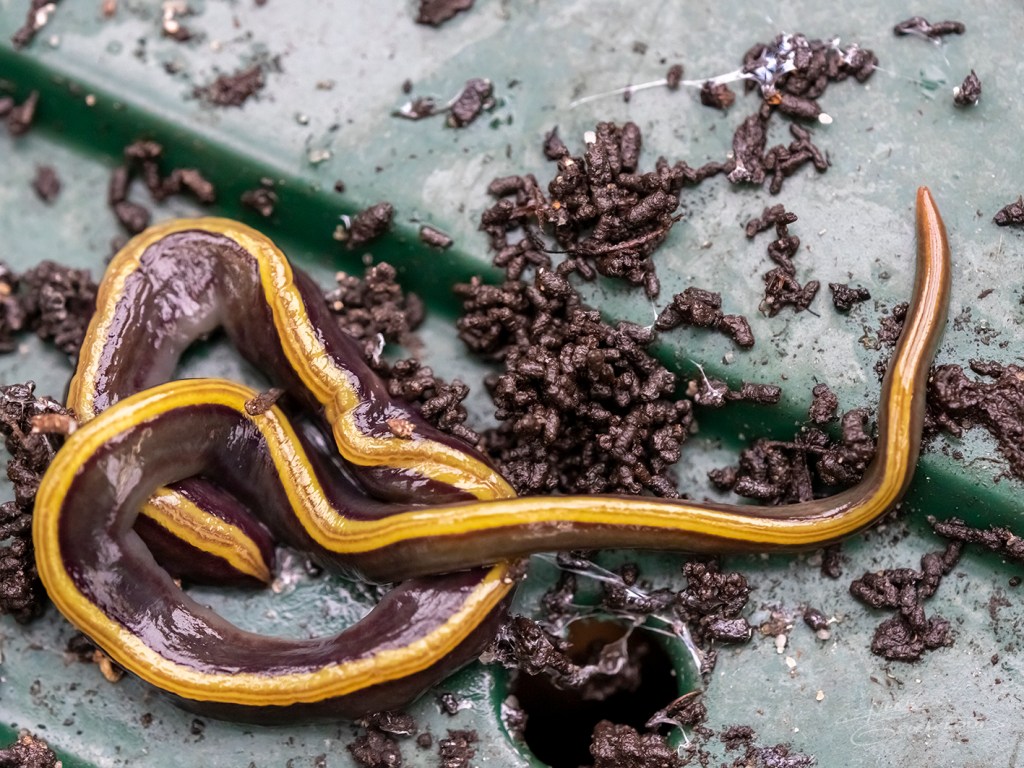
This weekend we did a search party in a butterfly garden. Turning pots and bricks to see what lives beneath. Perfect conditions for flatworms: humid, warm, organic material and lots of tiny creatures crawling in and on the soil. I was very proud to find two individuals of the yellow-striped terrestrial planarian (Caenoplana bicolor or Caenoplana variegata – Grote Australische geelstreep). As the name indicates, it is alien to Europe (look here). Alien, but no threat to biodiversity so not classified as ‘invasive’.
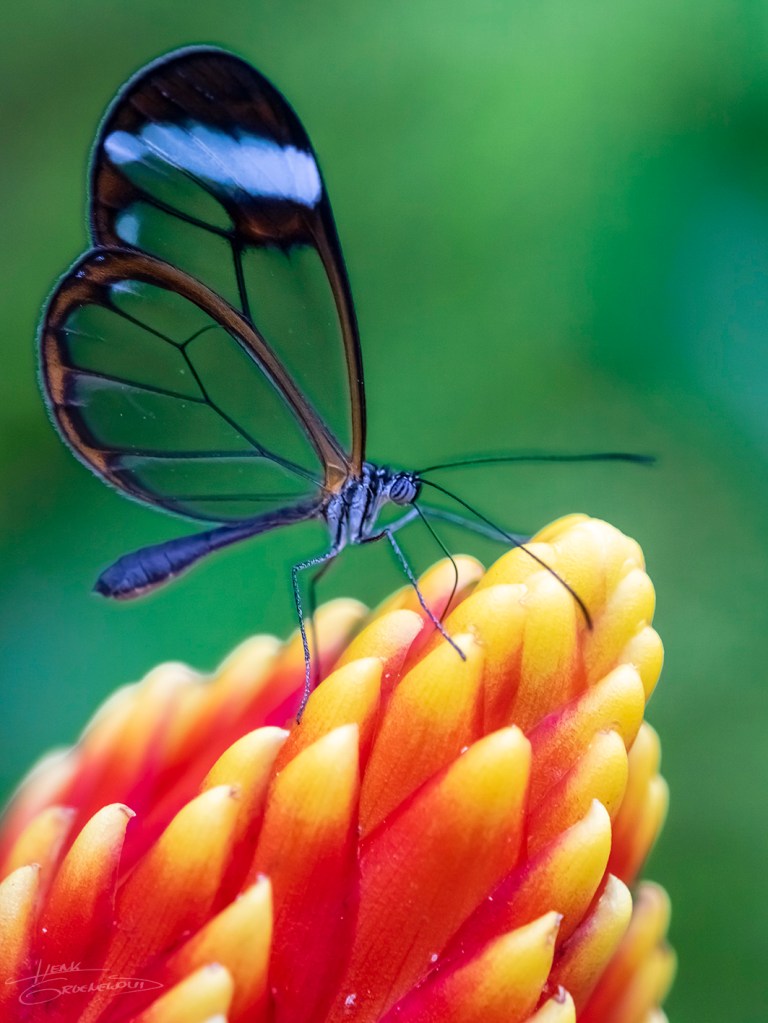
To ease your mind and make you sleep well, I’ll end this story with one of the butterflies of the garden. Sheer beauty.
It´s not what you see. It never is. It´s what you think you see.
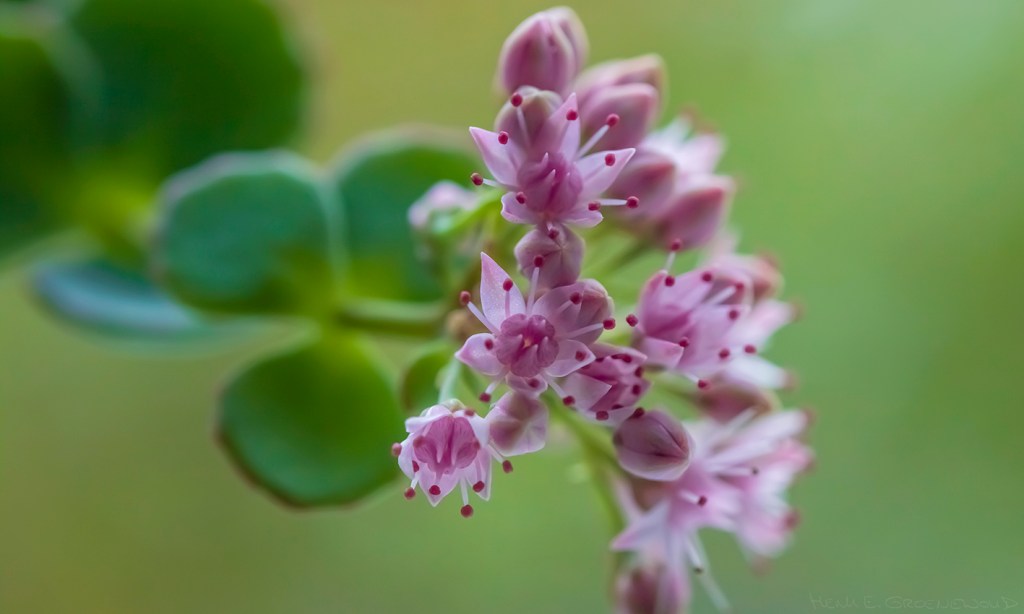
This is an ugly little plant. You might think it is nice, with delicate flowers, but that is because I´m a great photographer (– cough! –). It has been in our family for sixty years. It is tiny, with small leaves and even smaller flowers, and after flowering it shrivels, dies and disappears again.
And then after a short while, it comes back alive. As long as I can remember it has been in our house. My father made a little note that lies besides it: “No one ever said:‘What a nice little plant!’ We don’t think much of it either.”
But it’s not about what we see with our eyes. It’s what we see with our minds. It is a sole survivor of the flowers arrangements of my parent’s wedding. If I look at it, I see my parents wedding pictures. Amsterdam, black and white, sunny day and everyone radiating from happiness! A strong little fellow. It survived my mother, and it will probably survive my father as well. Who knows, it might even survive me…
I secretly took a cutting of it, and grew it at home. It needs little care, just a little light and a little water – not too much! It keeps on growing, flowering, dying and rising up again. Look really, really close, and see how beautiful these tiny flowers are!



 De Portrettenmaker